Tips & Tricks
Guitar Tricks
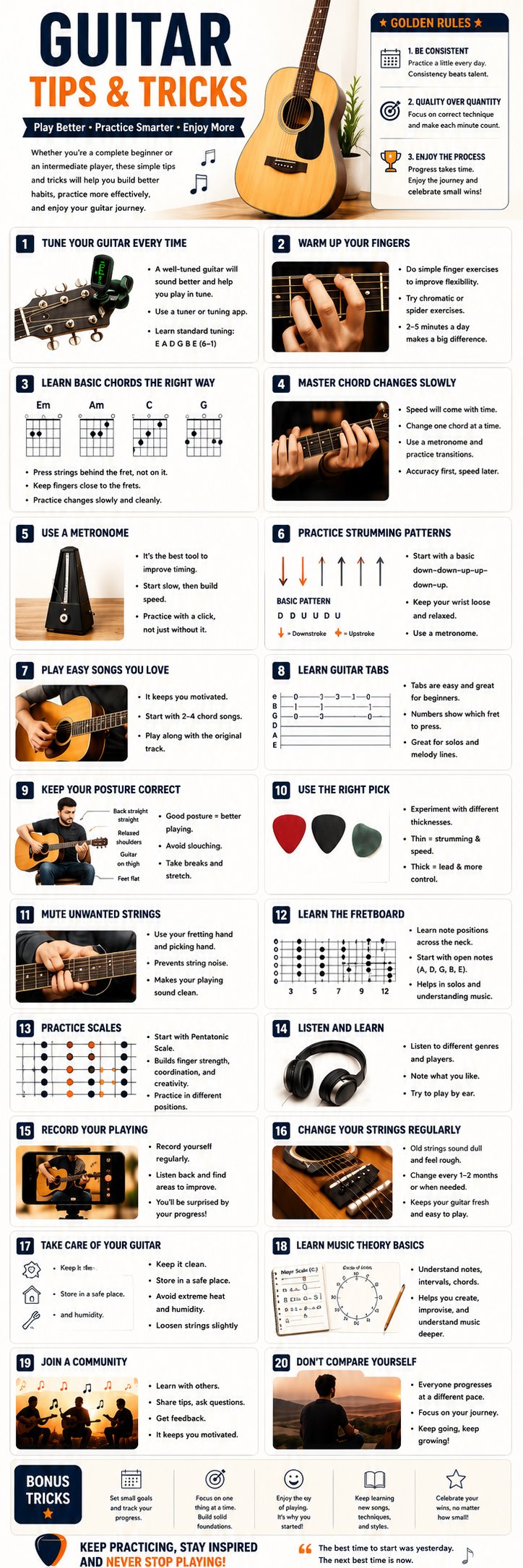
20 Guitar Tips and Tricks to Improve Your Playing Faster
Learning guitar becomes much easier when you practise the right things in the right way. Many beginners spend hours playing randomly but still struggle with chord changes, rhythm, finger pain and unclear notes. The problem is usually not a lack of talent. It is often the absence of a simple and consistent practice method.
The guitar tips and tricks in this guide will help you practise smarter, improve your technique and enjoy your learning journey. Whether you are holding a guitar for the first time or already know a few songs, these practical tips can help you become a more confident guitarist.
1. Tune Your Guitar Before Every Practice Session
Always tune your guitar before you start practising. An out-of-tune guitar will sound unpleasant even when you play the correct notes and chords.
You can use a clip-on tuner or a mobile guitar tuning application. Standard guitar tuning from the thickest string to the thinnest string is:
E – A – D – G – B – E
Tune every string slowly and avoid tightening it too much. Regular tuning will also help your ears gradually recognise the correct sound of each string.
2. Warm Up Your Fingers
Your fingers need a short warm-up before playing difficult chords, melodies or exercises.
Start with a simple chromatic exercise. Play the first, second, third and fourth frets using your index, middle, ring and little fingers. Move the same pattern across all six strings.
Practising this exercise for two to five minutes can improve finger flexibility, coordination and control. It can also reduce stiffness and make chord playing feel more comfortable.
Do not stretch your fingers aggressively. Your warm-up should feel controlled and comfortable.
3. Learn Basic Chords Correctly
Basic open chords are the foundation of thousands of songs. Start with beginner-friendly chords such as:
- E minor
- A minor
- C major
- G major
- D major
- E major
- A major
Place your fingers just behind the metal fret instead of directly on top of it. Keep your fingers curved so that they do not accidentally touch nearby strings.
Play every string separately after creating a chord. This will help you identify muted strings, buzzing notes or incorrect finger placement.
Focus on producing a clean sound before trying to play faster.
4. Practise Chord Changes Slowly
Knowing individual chords is not enough. You must also learn how to move smoothly from one chord to another.
Choose two chords, such as G major and C major. Play the first chord, pause and then move to the second. Repeat the change slowly.
Try to move your fingers together instead of placing them one at a time. Your hand will gradually remember the chord shapes through repetition.
Practise common chord changes such as:
- G to C
- C to D
- E minor to C
- A minor to C
- D to A
- A to E
Accuracy should come before speed. Once the movement becomes comfortable, your speed will improve naturally.
5. Use a Metronome
A metronome is one of the most useful tools for improving guitar timing.
Start at a slow speed, such as 50 or 60 beats per minute. Play one chord or note with every click. Make sure your playing remains steady.
When you can perform the exercise without stopping, increase the speed gradually.
Many beginners practise chords and songs without paying attention to rhythm. However, rhythm is what makes music feel organised and enjoyable. A simple song played with good timing will sound better than a difficult song played with an unstable rhythm.
6. Practise Different Strumming Patterns
Strumming adds rhythm and energy to your chords.
Begin with simple downstrokes. Count:
One, two, three, four.
Play one downstroke on each count. Once you can maintain a steady beat, add upstrokes.
A common beginner strumming pattern is:
Down – Down – Up – Up – Down – Up
Keep your wrist relaxed and hold the guitar pick gently. A tight wrist can make your strumming sound stiff.
Practise the movement on one chord before adding chord changes. You can also mute the strings with your fretting hand and focus only on the rhythm.
7. Play Easy Songs You Enjoy
Songs make guitar practice more interesting and meaningful.
Choose beginner songs that use two to four basic chords. Learn the chord progression first and play it slowly. Once you can change between the chords smoothly, add the strumming pattern.
Select songs that you genuinely enjoy listening to. You are more likely to practise regularly when you are excited about the song.
Do not worry about playing the exact original version immediately. Start with a simplified arrangement and gradually add more details.
8. Learn How to Read Guitar Tabs
Guitar tablature, commonly known as guitar tabs, is a simple way to read guitar music.
Tabs contain six horizontal lines representing the six guitar strings. Numbers written on the lines show which fret you should press.
The number 0 means that you should play the string open. The number 3 means that you should press the third fret.
Tabs are helpful for learning:
- Melodies
- Guitar riffs
- Song introductions
- Solos
- Fingerstyle arrangements
Tabs may not always show rhythm clearly, so listen to the original song while learning from them.
9. Maintain the Correct Guitar Posture
Good posture makes guitar playing easier and helps you avoid unnecessary pain.
Sit on a stable chair with your back straight. Keep your shoulders relaxed and place both feet comfortably on the floor.
Hold the guitar close to your body. Avoid bending your wrist too much while pressing the strings.
If you are right-handed, rest the guitar body on your right leg. If you are using a left-handed guitar, place it on your left leg.
Take short breaks during longer practice sessions. Stop playing if you experience sharp pain in your wrist, fingers, shoulder or back.
10. Use the Right Guitar Pick
Guitar picks are available in different shapes and thicknesses.
Thin picks are flexible and often comfortable for strumming. Medium picks are suitable for both strumming and basic lead playing. Thick picks provide more control for single notes, riffs and solos.
Experiment with different picks to discover what feels comfortable.
Hold the pick between your thumb and index finger. Keep only a small part of the pick visible and avoid holding it too tightly.
There is no single perfect pick for every guitarist. Your choice may change depending on the song and playing style.
11. Learn to Mute Unwanted Strings
String muting helps you produce a cleaner and more professional sound.
Sometimes a string continues vibrating even when it is not part of the chord or melody. This unwanted noise can make your playing sound unclear.
You can mute strings using your fretting hand or picking hand. For example, a finger can lightly touch a string that should not ring.
Muting takes time to develop, so begin by listening carefully for unnecessary string noise. Practise slowly and focus on controlling each sound.
12. Start Learning the Fretboard
You do not need to memorise the entire fretboard in one day.
Begin by learning the names of the open strings:
E – A – D – G – B – E
After that, learn the notes on the sixth and fifth strings. These notes are especially useful for power chords, barre chords and scales.
Remember that the musical notes follow this order:
A – B – C – D – E – F – G
After G, the sequence starts again from A.
Learning the fretboard will make it easier to understand chords, scales, melodies and music theory.
13. Practise Beginner Guitar Scales
Scales help improve finger strength, coordination, speed and musical understanding.
The minor pentatonic scale is a good starting point for beginners. It is commonly used in rock, blues and many popular guitar solos.
Practise scales slowly with a metronome. Use alternate picking by playing one downstroke followed by one upstroke.
Do not treat scales only as finger exercises. Listen to the sound of each note and try creating short melodies using the scale.
14. Listen to Different Guitar Players
Listening is an important part of learning music.
Pay attention to different guitarists and observe their rhythm, tone, phrasing and playing style. Listen to acoustic, rock, blues, classical, pop and fingerstyle guitar music.
Try to recognise whether the guitarist is playing chords, individual notes, fingerpicking or a combination of techniques.
You can also try learning short melodies by ear. Start with very simple tunes and find the notes on your guitar without using tabs.
15. Record Your Playing
Recording yourself can reveal mistakes that you may not notice while playing.
Use your phone to record a short practice session once a week. Play a song, chord progression, scale or exercise.
Listen to the recording and check:
- Are the chords clear?
- Is the rhythm steady?
- Are the chord changes smooth?
- Is there any unwanted string noise?
- Do you pause between difficult sections?
Keep your old recordings. Comparing them after a few weeks can show how much you have improved.
16. Change Your Guitar Strings When Needed
Old strings can sound dull, feel rough and become difficult to tune.
How often you should change your strings depends on how regularly you play. Some guitarists change them every month, while others use the same strings for several months.
You may need new strings when:
- The guitar sounds dull
- The strings look rusty
- The strings feel uncomfortable
- The guitar does not stay in tune
- A string is damaged
After changing strings, tune the guitar several times because new strings usually stretch during the first few days.
17. Take Care of Your Guitar
Proper guitar maintenance helps your instrument last longer.
Wipe the strings and guitar body with a soft, dry cloth after playing. Sweat and dust can damage strings and affect the guitar’s finish.
Store your guitar in a safe place using a guitar stand, padded bag or hard case. Avoid leaving it near direct sunlight, heaters, windows or areas with high humidity.
Never place the guitar in a position where it can easily fall.
A clean and properly maintained guitar feels better to play and stays in good condition for longer.
18. Learn Basic Music Theory
You can start playing guitar without knowing advanced music theory, but basic theory can make your learning easier.
Begin with simple topics such as:
- Musical notes
- Sharps and flats
- Major and minor chords
- Intervals
- Scales
- Chord progressions
- Rhythm and time signatures
Music theory helps you understand why certain chords sound good together. It also makes it easier to create melodies, write songs and communicate with other musicians.
Learn one small concept at a time and apply it directly to your guitar.
19. Learn With Other Guitarists
Joining a guitar community can help you stay motivated.
You can practise with friends, participate in online communities, join a local music group or share your progress with other learners.
Ask questions when you are confused and request feedback on your playing. You may also discover new songs, techniques and practice methods.
Playing with other musicians teaches you how to maintain rhythm, listen carefully and continue playing even after making a small mistake.
20. Do Not Compare Your Progress With Others
Every guitarist learns at a different speed.
Someone may learn chords quickly but struggle with rhythm. Another person may understand melodies easily but take longer to change chords.
Social media usually shows polished performances, not the hours of mistakes and practice behind them.
Compare your current playing with your own previous playing. Focus on small improvements, such as producing a clearer chord or completing a song without stopping.
Your goal is not to become better than another guitarist. Your goal is to continue becoming better than you were before.
Bonus Guitar Practice Tips
Set small and realistic weekly goals. For example, you can aim to learn two new chords, practise one strumming pattern or complete one beginner song.
Practise regularly instead of waiting for motivation. Even 20 minutes of focused daily practice can be more effective than practising for several hours only once a week.
Divide your practice session into smaller sections:
- 5 minutes of tuning and warm-up
- 5 minutes of chord practice
- 5 minutes of strumming
- 5 minutes of scales or tabs
- 10 minutes of song practice
Keep your routine flexible so that guitar practice remains enjoyable.
Final Thoughts
Improving at guitar does not require natural talent or extremely long practice sessions. It requires patience, correct technique and regular effort.
Tune your guitar, warm up your fingers, practise slowly and focus on producing a clean sound. Learn songs that you enjoy and record your playing to track your improvement.
Some days will feel easier than others. You may struggle with a chord for several days before it suddenly becomes comfortable. This is a normal part of learning.
Keep practising, stay patient and enjoy every small achievement. The more consistently you play, the more natural the guitar will begin to feel in your hands.
